
U-Cup seals are axial sealing elements designed for translational motion. Their development addresses the need for dynamic sealing elements that provide efficient sealing with minimal friction during operation. This reduces the risk of excessive seal damage and extends its service life.
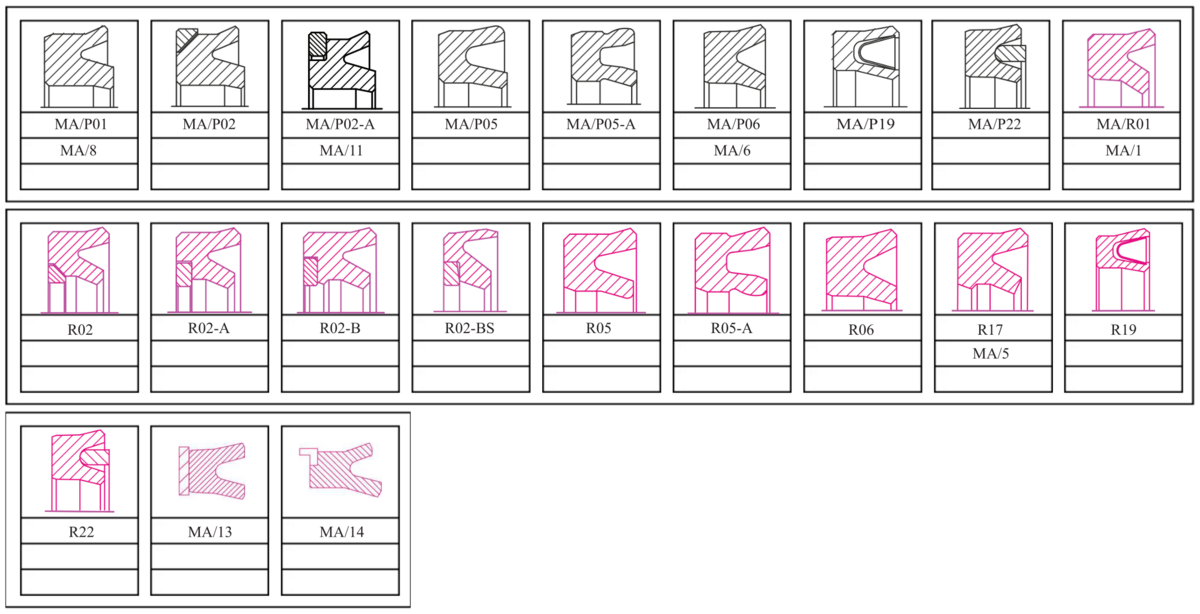
The profile of a seal consists of a sealing lip (edge) and a sturdy base part positioned in the installation groove. The base ensures stable mounting, which is crucial for sealing on the static sealing surface. At the same time, the base supports the seal within the groove, often eliminating the need for additional support rings. The shape of the sealing lips and the base is tailored to the specific tasks of the seal during operation. Their design considers demanding sealing conditions, including the type of seal (internal or external), the pressure level of the medium, and the movement speed.
A seal is an independent sealing element with elastic edges, primarily intended for dynamic sealing of translational movements across a wide range of pressures from the pressure medium. It is available in various shapes and adaptable to diverse operating conditions, with a selection of numerous materials.
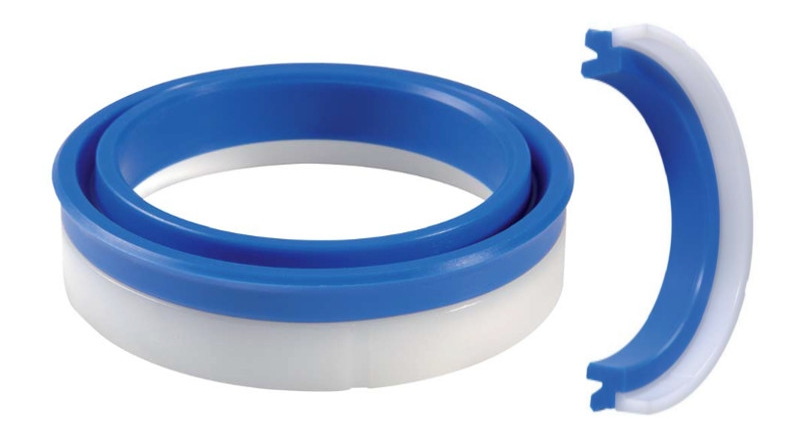
Sealing with a U-Cup seal is achieved by installing it in a groove approximately 10% wider than the seal itself. During installation, the sealing lips elastically deform, creating the necessary contact pressure (preload) between the seal edge and the surface. As the medium pressure increases, the pressure of the seal edge on the surface proportionally increases, ensuring effective sealing based on the principle of pressure and load.
At very high pressures, the cross-section of the seal expands radially, further increasing the contact area and sealing efficiency. However, this also increases friction, which can lead to damage or failure of the seal. Therefore, the correct selection of the seal is crucial to achieving an optimal balance between sealing, friction, and durability (shape, material).
By adding fabric to the rubber material of the seal, it becomes stronger and more durable under higher medium pressures. The fabric fibers create small "pockets" on the seal's surface, which trap lubricant during operation. This reduces friction and prevents damage, even under high pressures. Increasing the contact pressure between the seal and the sealing surface minimizes excessive friction and damage.
For specific needs, materials such as EPDM, VMQ, FPM, HNBR, and PTFE are used.
Advantages of U-Cup seals:
- Linear dependence between sealing effect and increase in medium pressure
- Excellent sealing across a wide pressure range
- Low coefficient of friction
- Simple groove design for installation
- Easy installation
- Wide variety of cross-section shapes and materials
- Broad range of applications (varied pressures, temperatures, and media)
Applications:
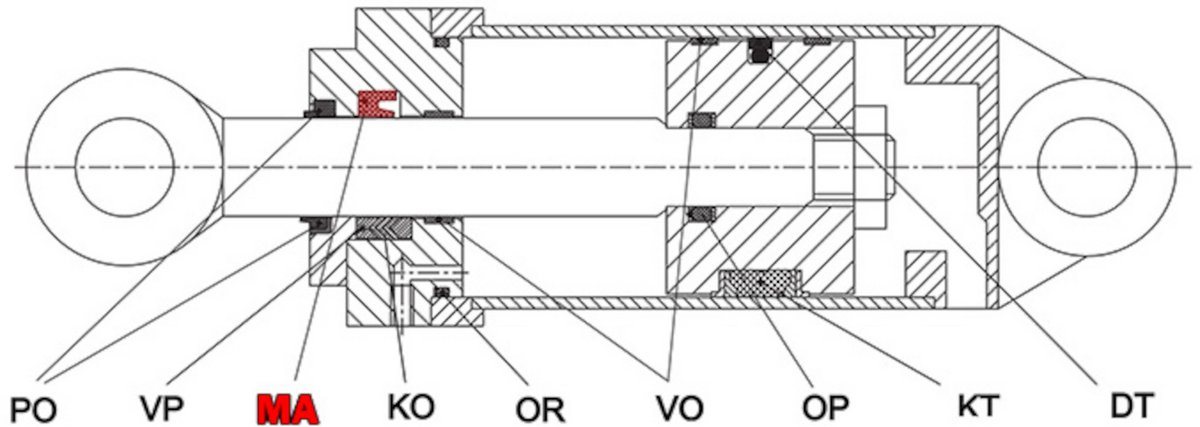
- Sealing pistons and rods in hydraulic and pneumatic cylinders
- Underwater plungers and fluid pumps
Instructions for Use:
Before installation, ensure the following:
- The specified grooves are properly machined on the cylinder, such as on the rod (with a rounding angle of 15–20°) to prevent mechanical damage to the seal during installation.
- All surfaces are free of sharp edges.
- The system is cleaned of foreign particles and contaminants.
- Seals and sealing elements must be oiled or greased before installation. It is recommended to use the medium intended for the system or a similar lubricant.
- Avoid lubricants containing solid particles or additives during installation.
- Use tools without sharp edges during installation to prevent damage.
Elastomers:
- PUR DIPUR-H
- NBR DIRUB-N
- HNBR
- FPM DIRUB-F
Thermoplastics:
- PTFE DIFLON-3 (40% bronze)
- PTFE DIFLON-1 (pure)
- PTFE DIFLON-2 (graphite)
- POM DITAL-1
-
 Datasheet 1 - MA (pdf) 492 KB